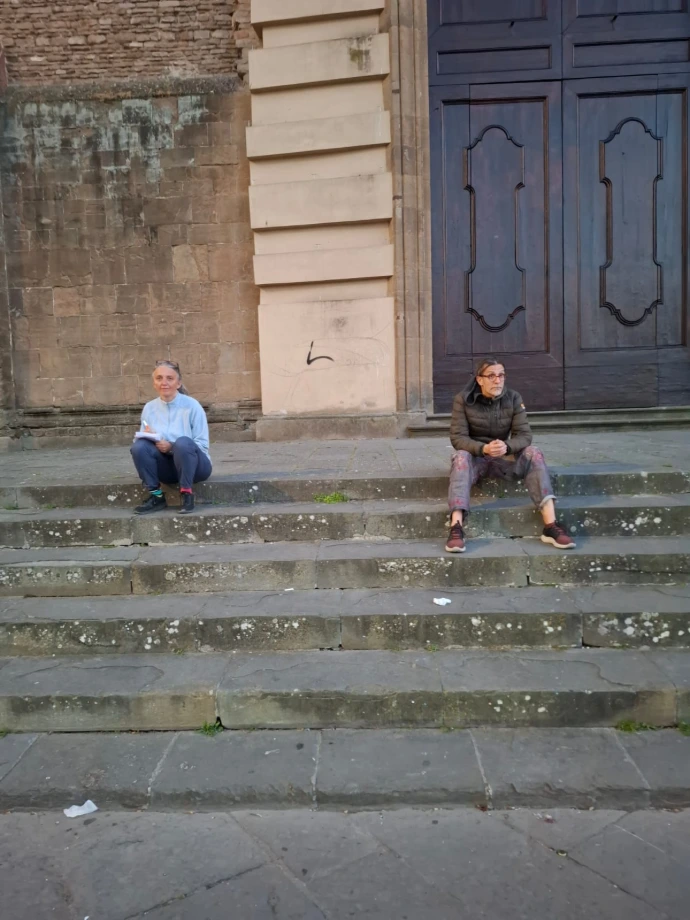
Before
The workshop was open to whoever showed up. Some had confirmed and did not come. Others arrived without warning. The number was never the point.
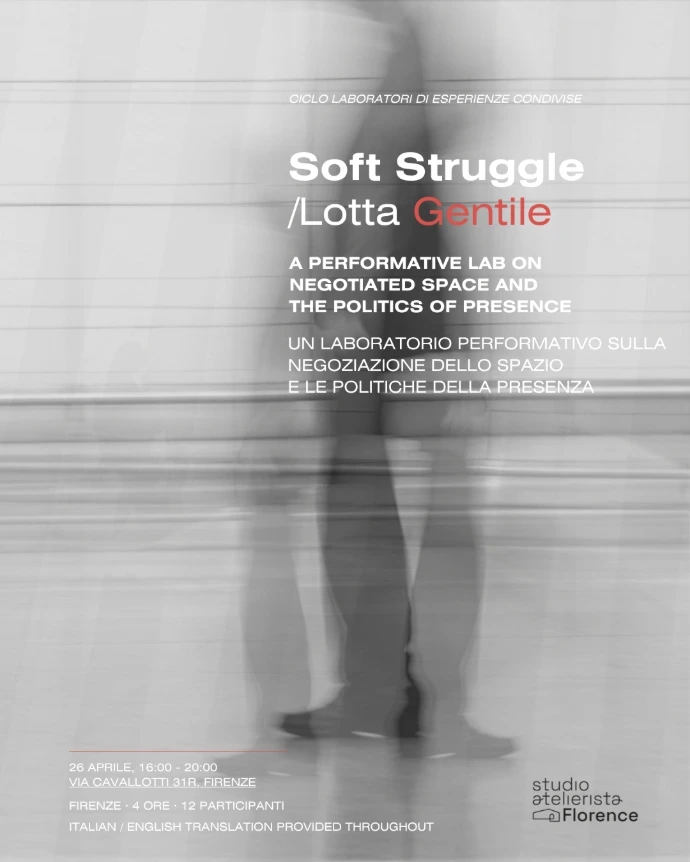
Four hours in a room learning how to be too much. Not too much on purpose. Not performatively. What happens when you do something ordinary at a volume, a duration, or a proximity that the space around you did not agree to in advance? Blowing your nose. Sitting on the ground. Reading aloud.
The room had rules, and everyone knew they were temporary, which made them easier to stretch.
The facilitators kept returning to the same question: how much space does a person take, and how much do they give back? It sounds abstract until you put it in a body. Then it becomes logistical. Then it becomes embarrassing.
We worked with scores — small repeatable structures: an action taken from the ordinary repertoire of a day (reading, writing, photographing, jumping, sitting), held for a duration, in relation to others. Togetherness turned out to be something continuously shaped by everyone present, and by absence itself. Less a state than a practice, unfinished by design.
If togetherness is the negotiation of shared space, it can also be understood as a kind of soft struggle. Who has the right to be where, and why? The arguments are surprisingly thin at their core. I was here first, therefore I belong here. There are more of us, therefore this is ours. These fragile claims organise how we sit, move, and rest — the same logic that underpins territories and borders.
The limits of what fits in public are always shifting. Blowing your nose loudly is acceptable, up to a point. But where is the point? What happens if twenty people join? If a cordon forms around the person doing it? One of the facilitators put it back to the room as a question nobody answered: does an action become more legitimate through repetition, or through context — and can repetition itself produce context?
We did not set out to claim space. We set out to test whether presence can be negotiated at all, and whether that negotiation can hold what usually falls outside it: being too loud, too visible, too many, too long.
The square
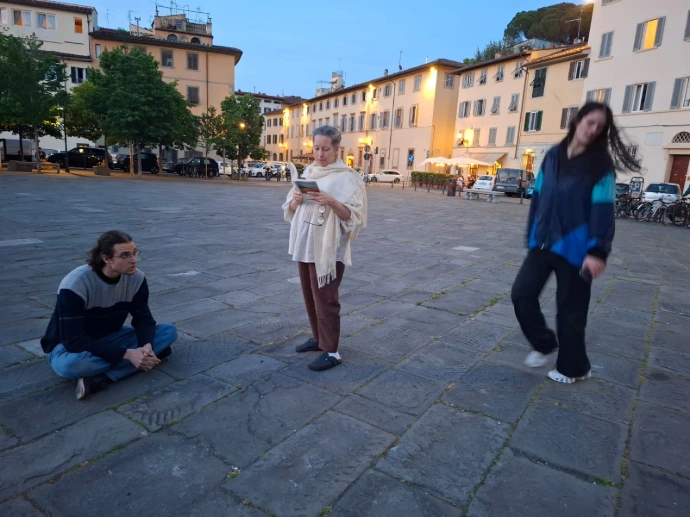
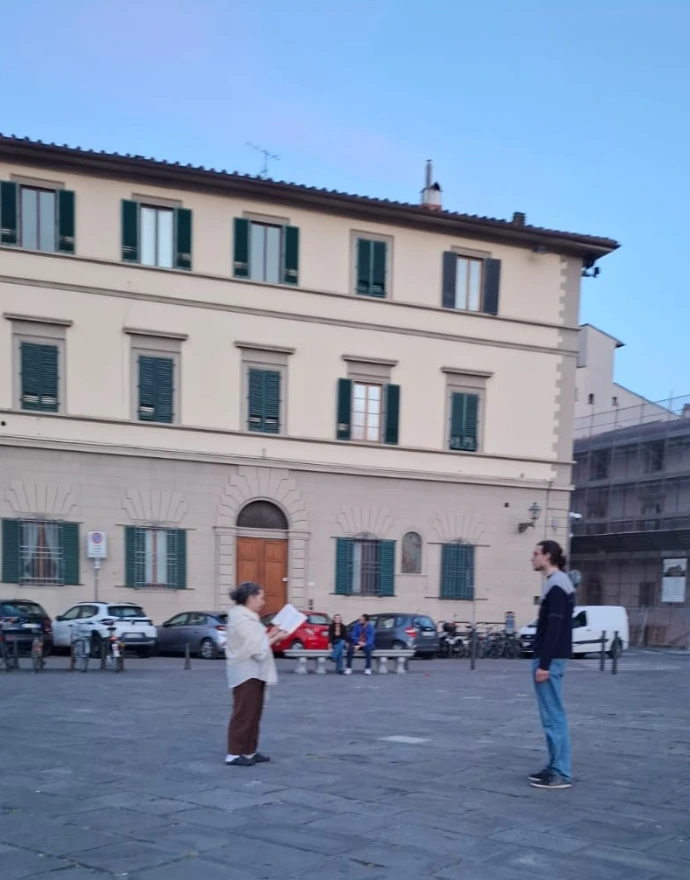
Piazza del Carmine at nine in the evening. The church facade lit from below, the benches mostly empty, a few teenagers on scooters circling the perimeter. The group dispersed into individual scores, each one an activity anybody does without thinking: reading, taking photographs, writing, jumping, sitting still.
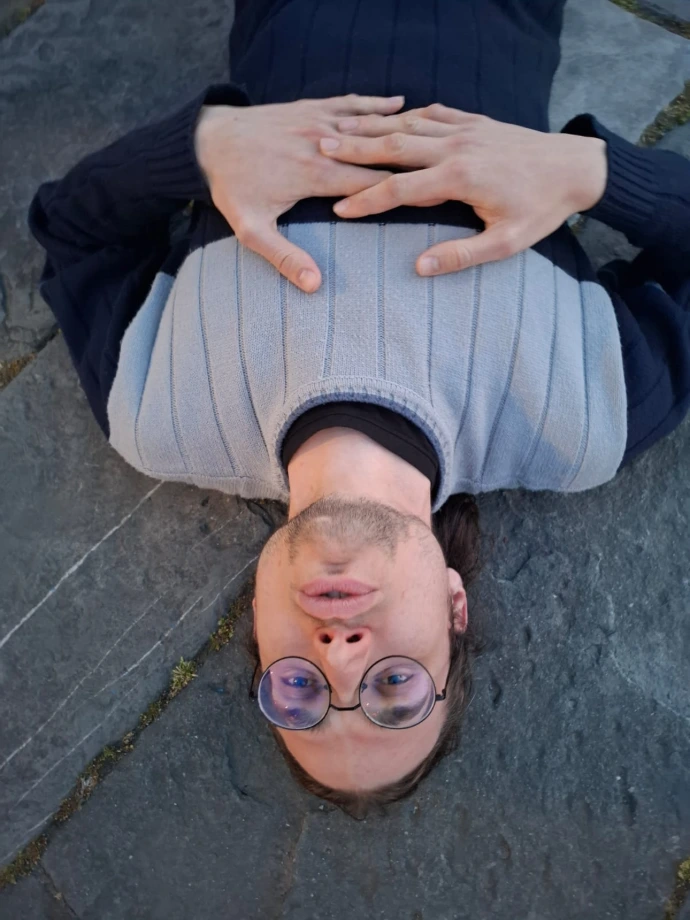
One person lay down on the stone in front of the church steps and sang — a thin voice, a song half-remembered from childhood, the stone cold underneath. A couple stopped, then walked on. A man with a dog stood for a full minute, then said "Brava" in a tone it was impossible to read.
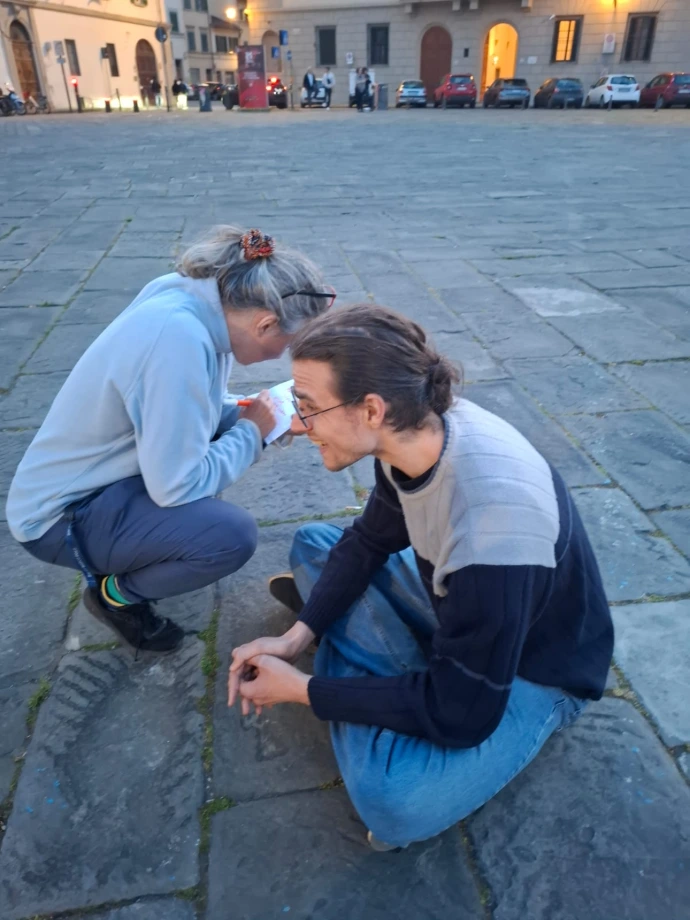
Two others crouched facing each other over a small piece of paper, writing slowly, passing a single pen back and forth. They did not look up. A group of tourists photographed the church and included them in the frame by accident, then noticed, then hesitated — should they ask? should they wait? — and moved on.
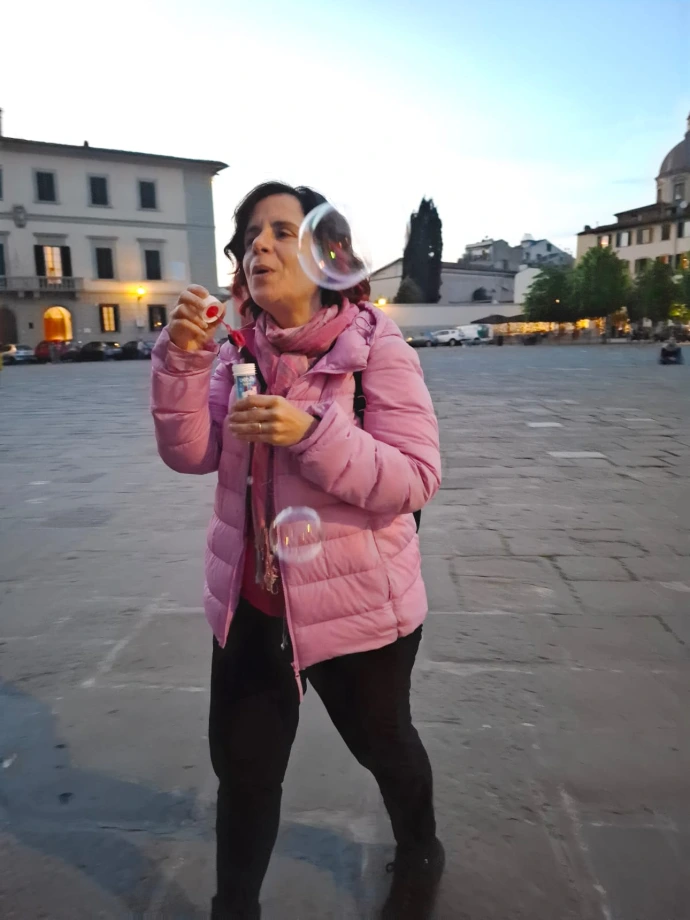
Someone blew soap bubbles. They drifted toward a table where four people were drinking wine. One of the drinkers reached out and popped one. Nobody laughed. The bubble-blower kept blowing.
Another person sat still on a bench, not looking at a phone, not waiting for anyone. A woman walking past slowed down, then sped up, as though stillness were contagious and she did not want to catch it.
A man in running clothes asked what was happening. The person nearest to him stopped mid-phrase and said, "I don't know. I'm just here." The runner nodded, unsatisfied, and continued his lap.
What happened
For roughly twenty minutes the square held two systems at once: the usual one, where people cross with purpose, and another one where purpose had been suspended. They did not clash. They negotiated without speaking. The scooters gave the group a wider berth on their third pass. The wine drinkers stopped popping bubbles. The woman who had sped up came back and sat on a different bench — still not looking, but present.
Then one person stood, gathered their bag, and left. No announcement. Nobody acknowledged it, and that was the agreement: no goodbyes, no explanations. But the space changed. The remaining participants re-arranged themselves slightly, without deciding to, filling the gap before anyone could name what had shifted.
The square was being regulated by everyone in it — by passersby, by numbers, by attention, by the silent agreements and disagreements of a crowd. The scores had become a collective presence. And that presence was being read, adjusted to, ignored — regulated by the square itself.
What did not happen
No police came. Nobody was asked to leave. There was no confrontation, no manifesto, no audience that stayed. The square absorbed the intrusion and kept functioning. That was both the success and the limit of the exercise: the space was flexible enough to accommodate the strangeness, and flexible enough to forget it immediately.
The facilitators' question — how much space does a person take — turned out to have a modest answer in practice. Less than you would think. A body can lie on stone and sing, and the city continues around it. The struggle was not with authority, or with the public, but with the body's own urge to justify itself, to prove its utility, to shrink when unacknowledged.
After
The group reconvened at the edge of the square. Nobody described what they had done.
What came instead, again and again, was a word close to permission. The bubbles, the jumping, the reading, the writing, the singing: none of it had needed to arrive anywhere. There was no audience to satisfy, no result to produce, no correct way to do an ordinary action in public. Someone said this was the unfamiliar part — not the exposure, which they had expected, but the absence of a purpose to justify it. None of it was extraordinary. That was the material: the ordinary things a body does anyway, done slowly enough, or long enough, or publicly enough that they stop being invisible.
Some had wanted to go further than they went. That gap was left open. Not interpreting is part of the frame of this work — an ethics of abstinence, in which the facilitator withholds the reading that would close the experience for the person having it. So they asked only: what did the space allow, and what did you allow yourself?
The city closed over the whole thing and kept no record of it. Something did happen, but it happened inside the people who were there: a permission no one had to grant and no one had to give back.
The facilitators
Barabás Szigeti is a performer, director and theatre researcher. He works on the fragility of representation, building a stage language that makes the formation of an image visible while it is happening, before it settles into meaning. Light, sound and composition are handled live; the timing of a scene belongs to the performers or to no one.
Kadence Luella Neill is a choreographer, performer and writer, working between dance, theatre and collective composition. She holds not-knowing as part of any creative process, working with grief, thresholds, and what cannot be fully known. She lives between Helsinki and New York.