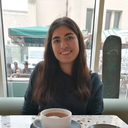
Giulia is a 23-year-old Italian volunteer currently doing her European Solidarity Corps placement with Associazione Antigóna, one of WellSpaces' leading organisations. In this piece, she reflects on privilege, belonging, and what it means to look for home.
Rather than offering answers, her story invites us to pause and reflect on the different realities that shape our lives.
The Scent of Wait
The place I grew up in no longer felt like home, so I left.
In a way, I am a migrant too.
However, mine is a chosen, reversible, protected migration. It does not arise from the need to escape, but from the need to seek.
Seeking an “elsewhere”, a new balance, a different way of inhabiting the world.
When I decided to leave for a European Solidarity Corps project in Lithuania, I wasn’t simply looking for an experience abroad.
I was looking for a place where I could find myself again, after having progressively lost the familiarity I once felt towards the context I had grown up in.
Ultimately, I was looking for the possibility of recognizing a new idea of home.
Over time, however, this distinction between “those who leave by choice” and “those who leave out of necessity” had begun to lose clarity.
The action is the same: leaving something behind to look for an “elsewhere”. What changes is everything that makes that action possible.
My project is divided between Vilnius and Pabradė.
In Vilnius I work in a Caritas center for foreign people, in an environment marked by different languages, educational activities, workshops and social moments.
Then there’s Pabradė.
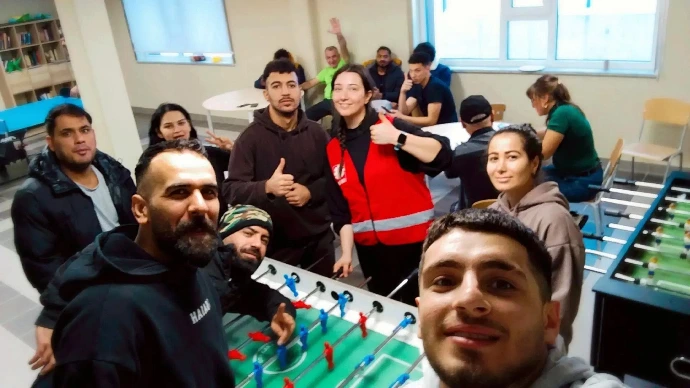
Twice a week I leave the city and head to the asylum seekers shelter.
Every time I pass through the gate, it’s like I’m entering another dimension of time.
And, even before people, a scent greets me.
It’s not a scent you can easily define.
It’s not only about the space shared by many people.
It’s something more indefinite: suspension, wait, precariousness. It's the scent of a time that doesn't move forward but remains stuck in an indefinite “after”.
It's the scent of lives that don't know when they’ll be able to find a direction again.
Afterwards, however, the context rapidly changes. Greetings arrive, smiles, someone who pronounces my name with faraway accents, someone who offers tea or food, someone who drags me into a game of soccer or ping pong.
The initial distance is solved in a relationship.
As the weeks went by, however, something became clearer, and harder to ignore.
I came to Lithuania to look for a home.
The people I meet in Pabradė came here because they had to leave one.
I chose to leave. They didn’t.
I can call my mother whenever I want, and I can also choose not to. I can buy a ticket and return to Italy. I can decide.
For many of the people I meet, the word “return” doesn't have the same structure. In some cases, it doesn’t exist at all.
This is where privilege ceases to be a concept and becomes a concrete, everyday condition.
Never being questioned as a “second-class immigrant”. Not having to justify your presence beyond a border. Being recognized as a volunteer, never as someone whose presence is problematic or suspect. And, above all, being able to cross spaces without having to constantly explain your being there.
None of this is an individual achievement. It’s the result of where I was born.
In the past months, I’ve heard stories that should hardly be shared by twenty-year-olds. One of them concerns an Afghan boy who endured years of violence, flight, and precarious conditions along the migration routes to Europe.
I won’t go into details: some stories demand respect above all else.
Later, he told me that, despite everything he’d been through, he could still see a little light through me.
That sentence moved me but, at the same time, made me uncomfortable.
Because that light doesn’t belong to me.
I'm not here to save anyone. I'm a volunteer. I can share time, activities, and my ability to listen. I can help build moments of normality in contexts that aren’t normal. Then I leave.
I cross the gate and return to a place I can return to. They stay.
The public discourse on migration often tends to reduce it to administrative categories, numbers, emergencies, or borders.
But what you encounter every day in the field is something else: people.
People who laugh, care for others, share what they have, learn new languages while slowly losing their own, and continue to develop relationships even in conditions of extreme instability.
I left looking for a place to call home.
I met people who had to leave home.
The two trajectories are similar in their action but remain profoundly unequal in the conditions that make them possible.
Lithuania, my volunteering, they have given me back energy and a new form of presence in the world. But it has also forced upon me an awareness that is difficult to escape.
Home, for me, continues to exist. It is a place I can return to. It is an always open possibility.
For many of the people I meet in Pabradė, home is a memory, a loss, sometimes a fracture.
And perhaps it is in this asymmetry that everything this experience is teaching me stands.
Read more about Giulia
Her volunteering journey, however, began in high school, when she shared her time at the Provincial Centre for Adult Education in Busto Arsizio as part of a school-to-work programme and at the non-profit organization Liberi di Crescere, supporting both adults and children.
She later earned a Bachelor's degree in International Sciences and European Institutions at the University of Milan.
Driven by her interest in international cooperation and intercultural exchange, she joined a volunteering project in Madagascar, where she taught English and Italian while living with orphaned girls aged between the age of 4 and 8.
As she beautifully puts it, through these past experiences she “discovered the beauty of unexpected relationships and how inclusion makes a community stronger”, values she continues to bring to her European Solidarity Corps volunteering.