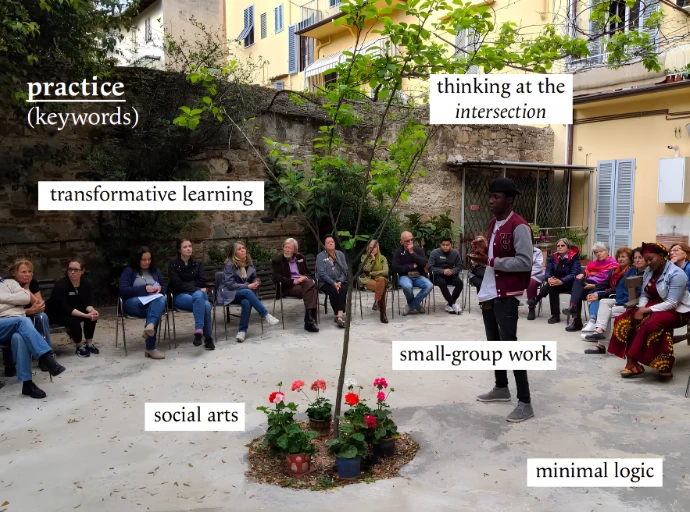
Un desafío de capacidades, no solo de problemas
What if the crises we face—ecological, political, social—are not separate issues but folds within the same fabric? What if tackling them demands not only new strategies, but new capacities to perceive, relate and respond?
ParamitaLab works at this intersection. Our practice—fieldwork within the subject—creates the conditions where each person's singularity may emerge as generative difference that transforms the collective.
We accompany educators, activists, artists, communities and institutions through processes where transformation arises not from external solutions, but from cultivating the capacity to respond from within complexity itself.
Habitamos y trabajamos en las fronteras fértiles entre arte, educación y práctica social, ese territorio donde las categorías se vuelven porosas y algo del orden de lo nuevo puede ocurrir. Usamos el arte no como mera ilustración, sino como medio de conocimiento y transformación.
No trabajamos desde protocolos o soluciones predefinidas. Sostenemos dispositivos donde pueda emerger algo del orden de lo genuinamente nuevo: no solo nuevos entendimientos, sino nuevas capacidades de respuesta.
Trabajamos con y desde la complejidad, no contra ella. Evitamos la simplificación. Habitamos la paradoja, actuamos desde la raíz, y confiamos en que la transformación profunda emerge al cambiar la manera de percibir, de relacionar y de estar presente.
Proyectos con liderazgo orgánico
Trabajamos con una estructura basada en proyectos, inspirada en el comportamiento de las bandadas de pájaros, en las que el liderazgo surge de forma orgánica según el contexto y la experiencia, en lugar de depender de roles fijos predeterminados.
Operamos sin jerarquías fijas, desde una estructura orgánica que permite que cada proyecto tome su propia forma. Nos reconocemos como instrumentos de una decisión colectiva, asumiendo con responsabilidad el cuidado ético de cada encuentro.
Fieldwork within the subject
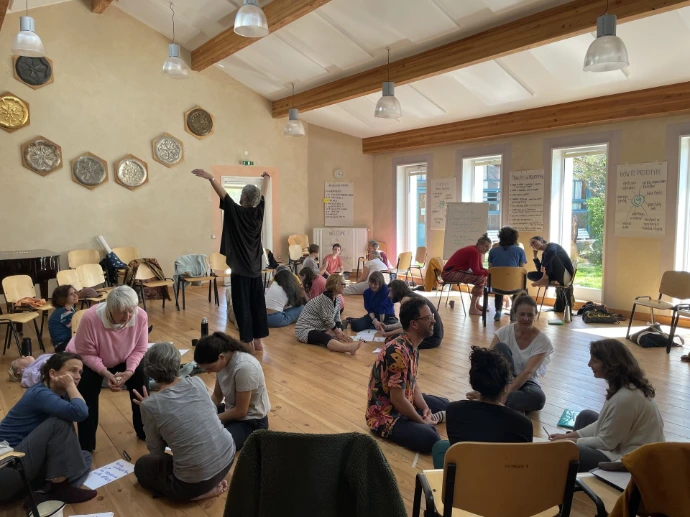
Hacer campo en el sujeto significa crear las condiciones relacionales donde la singularidad de cada quien —esa manera única de habitar la incompletitud constitutiva— pueda advenir como diferencia generativa que transforma la trama colectiva. Campo entendido como condición para que algo se desplace en el que participa del encuentro, un movimiento en la posición desde la que percibe y responde.
Trabajamos en ámbitos no terapéuticos, desde el sostén relacional. Quien facilita sostiene las condiciones y la direccionalidad del espacio para esta apertura del sujeto desde una función asimétrica, pero no dirige ni interpreta: acompaña lo que emerge habitando la tensión de no saber. En esa incógnita compartida se abre la posibilidad de pasar de la reacción condicionada a la respuesta singular. El valor reside en la diferencia que cada acto introduce en la trama compartida, ampliando lo común, y no en una esencia previa.
No trabajamos en solitario. La supervisión e inter-visión son esenciales. Sostenemos espacios donde quienes acompañamos elaboramos lo que nos acontece: tanto lo que se moviliza en cada uno como sujeto, como lo que ese movimiento aporta a la práctica colectiva y al proyecto compartido. Sostenemos un lugar donde la ética del encuentro se cuida de forma activa, y donde lo que ocurre en el campo se transforma en saber practicable que retorna a lo colectivo, sin disolverse o perderse.
Relational holding and mixed economy
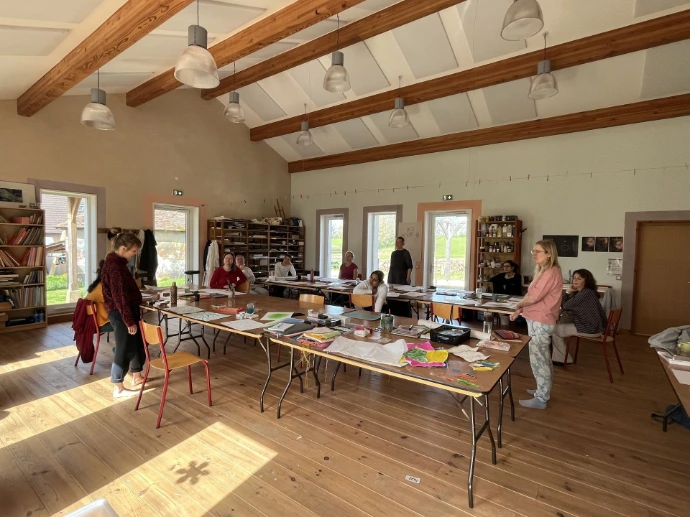
Procuramos trabajar siempre desde un sostén relacional, no con protocolos predefinidos. Atendemos al contexto y las necesidades de quienes llegan y a partir de allí definimos distintas formas de trabajo: laboratorios intensivos de exploración, acompañamientos colaborativos con organizaciones y co-creación de proyectos que eventualmente toman autonomía propia. Sostenemos dispositivos donde acontecen nuevas capacidades de percibir, relacionar y responder, y donde lo que cada quien aporta modifica la trama común.
Este trabajo se sostiene y sustenta de forma colectiva y diversificada. Económicamente, mediante una combinación deliberada de (i) trabajos pagos que sostienen la infraestructura, (ii) iniciativas con espíritu de don o dádiva que nutren la experimentación, y (iii) mediante la participación en programas europeos de colaboración. Esta diversidad de formas de sostén no es arbitraria: refleja directamente el tipo de trabajo que hacemos y la diversidad de públicos y contextos con los que colaboramos.
Lo que hacemos: cuatro dimensiones entrelazadas
Cultivar la capacidad interior de ser afectado, de responder, de estar abierto a lo que el mundo nos comunica. Porque quien experimenta profundamente esa resonancia encuentra en ella una disposición posible hacia lo que se le presenta.
El hacer no se separa del pensar ni del sentir. Nuestra práctica es encarnada: sostenemos dispositivos donde el conocimiento emerge del encuentro, de la experimentación compartida, del acto concreto en contextos relacionales vivos donde no se desprecia la corporalidad con su esfera de sensibilidad.
We work with groups because transformation arises from the relational fabric: each singularity that emerges in the shared space modifies the weave that sustains it. The group is the living space where the singular and the collective co-constitute one another.
La reflexión no es únicamente posterior a la práctica: nombramos lo que acontece, elaboramos lo que emerge, conceptualizamos desde la experiencia vivida. Reflexión en la acción y reflexión sobre la acción se entrelazan y producen saberes distintos y complementarios.
Desde dónde lo hacemos: cuatro registros que respiran juntos
Estos cuatro aspectos —capacitación, práctica, relacionalidad y reflexión— no son etapas secuenciales sino dimensiones entrelazadas. Se despliegan a través de cuatro registros o dimensiones que sostienen un doble movimiento: por un lado, crear las condiciones donde cada singularidad encuentra su voz y, por el otro, revelar en cada encuentro algo que ninguna singularidad portaba por sí sola.
The human being is born in relation. From the outset, subsistence depends upon another who receives, nourishes and sustains. The marks of those primary bonds shape the manner in which we establish our union with the transcendent and enduring. We are, from the very origin, relational beings.
Por eso la transformación no ocurre "en" los sujetos de manera aislada, sino en el espacio relacional compartido. Nuestra práctica cultiva la capacidad de ser afectados juntos, de encontrarnos en ese espacio donde la resonancia mutua puede reconfigurar cómo percibimos, nos relacionamos y respondemos.
We work with the subject’s complexity across three dimensions: the symbolic (the language and culture that constitute us), the imaginary (desires, projections, identifications) and the Real (that which resists symbolization and returns).
The subject is not a unified entity transparent to itself. It is constituted by language, traversed by dimensions it does not fully command. This incompleteness is not a defect to be repaired, but the opening from which something new may emerge.
We work with this constitutive gap —the space where the subject does not fully coincide with itself— as the generative place from which a singular, non-automatic response may arise.
Every living being carries within itself a tendency to persist, grow and expand its capacity to act in the world. Our practice attempts to create the conditions for this life force to manifest, so that each subject may unfold their potency more fully.
Even so, the human subject is not a closed, autonomous entity. It ex-sists: it is always already in the world, constituted by language, decentered from itself. This understanding —that the subject does not fully possess itself— traverses our entire practice.
Far from working from the illusion of the sovereign subject that fully knows and controls itself, we operate from the recognition that the subject emerges in relation, in language, in encounter.
We sustain basic goodness: the inherent potential in each being to move toward coherence, compassion and creative expression. And we trust that this potential can unfold when conditions are held for incompleteness to become generative opening.
Nuestra práctica es también política porque creamos espacios ecosistémicos, reconociendo que la transformación requiere más que representación; requiere una construcción genuinamente colectiva. Valoramos a cada sujeto por la diferencia que su forma singular de responder introduce en lo común. Se trata de una ética del acto: sin garantías, con la responsabilidad plena de sostener las condiciones en las que cada singularidad puede manifestarse como una diferencia que amplía el orden de lo posible y transforma la trama colectiva.
We are aware that we are but instruments of a collective decision, yet we fully assume the duties and responsibilities this entails. There is no contradiction between recognising ourselves as bearers of something that exceeds us and responding with total responsibility: precisely because each concrete act responds to a collective intention, it demands the utmost commitment and the greatest ethical attention.